
Breaking Free from the Fear-Avoidance Cycle
What we don’t understand, we fear.
What we fear, we judge as evil.
What we judge as evil, we attempt to control.
And what we cannot control…we attack.
—Anonymous
This anonymous quote seems quite applicable to pain. Many of us don’t understand pain and it’s protective role, which leads us to naturally fear it. Driven by our fear and desire to avoid pain we perceive it as an enemy that needs to be defeated at any cost.
The metaphor of pain as the enemy is evident in the how we treat it with painkillers and refer to the “battle” against pain. When we can’t control the pain we fight it and use every means available to attack and eradicate the unpleasant sensation.
Ironically, this fear-driven struggle can become part of the fear-avoidance cycle which reinforces the very pain we’re trying to escape.
Controlling Pain Through Avoidance
Often our logical strategy to take control of our pain is to avoid activities we believe will make it worse. This response makes perfect sense. If walking, bending over, lifting, biking, or any other movement has been painful in the past, it is reasonable to expect those activities to hurt again, or even cause damage.
Unfortunately, with time and repetition these experiences can lead to a fear of movement. And when that fear becomes excessive and persistent, it is known as kinesiophobia.
Kinesiophobia: “the avoidance of activity because you fear it will cause pain.”
—Norman J. Marcus, MD
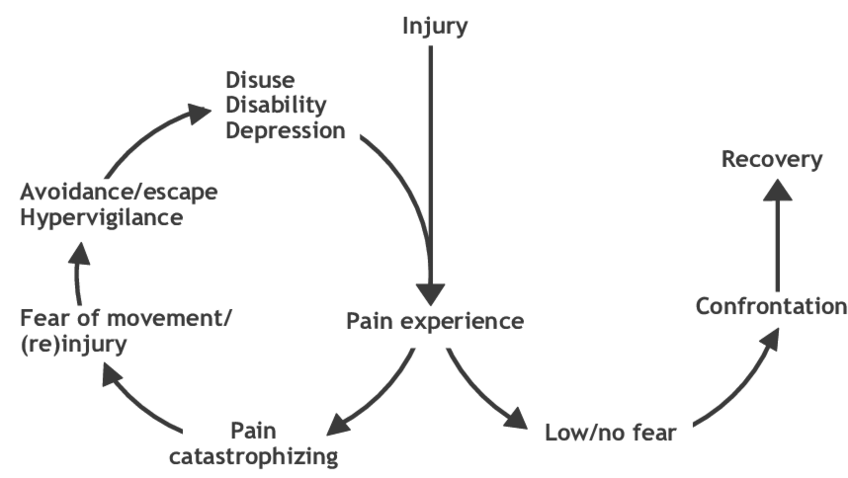
If you refer to the image of the Fear-Avoidance Model (FAM) at the top of this blog you will see that fear comes before avoidance. Pain is interpreted as a sign of danger, leading to fear of movement or (re)injury. Our anxiety about the pain causes us to respond with avoidance, escape behaviors, and increased vigilance to pain and bodily sensations.
Although avoidance helps to control the pain in the short term, the longer we avoid moving the less active, less confident, and more distanced we become from favorite activities. Inadvertently, we are also reinforcing that movement is unsafe to our nervous system which can cause increased protection and increased pain. As a result, we progress around the cycle to the next stage—disuse, disability, and depression.
The cycle is self-reinforcing and grows stronger with each repetition. Looking closely at the model you will see that the left side is a continuous loop that does not lead to recovery.
To break out of the loop and recover requires a different strategy of control. Perhaps the greatest source of control isn’t trying to eliminate pain but rather is learning to reduce the fear surrounding it. Let’s take a closer look at this model.
Understanding The Fear-Avoidance Model (FAM)
How we emotionally, behaviorally, and mentally respond to an injury has a profound impact on our recovery. These responses are often tied to what we understand about the pain and think it means for our future. The FAM depicts the two very different journeys we can take after an injury.
Starting at the top of the model is an initial injury which leads to a pain experience. Everyone’s journey begins the same. The progression from injury to pain is normal and necessary. Injuries hurt and pain protects us and helps us heal. However, it is how we emotionally respond, specifically our fear reaction, to the pain experience that determines our direction. In other words, the path we take depends less on the pain itself and more on how we interpret the meaning of the pain.
If we believe the pain is a normal part of healing and trust that movement can be safe, we are more likely to experience a manageable level of concern rather than overwhelming fear. In the FAM, this leads us to the right side of the diagram, the route to recovery.
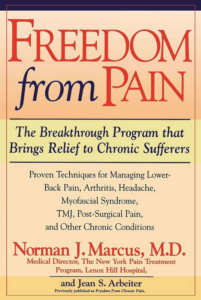 In contrast, if we believe the pain is a sign of ongoing danger our fear increases, uncertainty grows, and we may begin to feel overwhelmed by the pain. This often leads to pain catastrophizing which is defined by Dr. Norman J. Marcus, a physician specializing in pain management and research, in his book Freedom from Pain, as follows:
“Catastrophizing involves the continual expression of negative emotions: ‘I’m frustrated.’ ‘I’m depressed.’ ‘I’m defeated.’ It means expecting the worst, […] it means turning every twinge of pain, every disappointment […] into a perception of disaster.”
Pain Catastrophizing: When Fear is Narrating Your Story
Pain catastrophizing is a mental/emotional response to pain that is driven by fear and shapes our Pain Story. From pain catastrophizing, the cycle can gain momentum. Fear encourages avoidance, avoidance emphasizes the perception of danger, and the nervous system becomes increasingly protective making the pain more intense.
Each trip around the cycle reinforces the same story: ‘I am not safe.’ When we feel threatened, we are more likely to experience pain, read more in this blog, Pain: A Balancing Act Between Feeling Safe or Threatened.
Thus, what began as an injury evolves into an unending loop that limits movement, erodes self-reliance, reduces participation in meaningful activities, undermines hope, and diminishes overall quality of life.
The encouraging news is that breaking out of the cycle is possible. By learning how pain really works, questioning fearful assumptions, and gradually creating new experiences of safety, it is possible to change the narrative. When fear is no longer the author of your Pain Story, the cycle can be broken.
Break the Cycle with Knowledge
Recall the first line of the anonymous quote
What we don’t understand, we fear.
It makes sense that if you don’t know why you hurt, the pain seems unpredictable, and you feel helpless to do anything to change it you will be afraid. But, as demonstrated in the FAM, fear grows the longer you have the pain and avoiding activity can quickly progress to disability, lost enjoyment of life, and a shrinking world.
The way out of the cycle takes courage that is built through understanding.
The cycle will not be broken by ignoring or pushing through the pain. Turning right towards recovery when you have a pain experience requires more than willpower. It requires both a knowledge of pain science and knowledge of yourself.
Ready to take the next step?
Transform your fear with knowledge and step out of the cycle. Join our next Explain Pain® Group.
References
Linton, S., & Vlaeyen, J. (2000). Fear-avoidance and its consequences in chronic musculoskeletal pain: a state of the art. Pain, 85(3), 317–332. https://doi.org/10.1016/S0304-3959(99)00242-0
Marcus, N. J., & Arbeiter, J. S. (1995). Freedom From Pain: The Breakthrough Program that Brings Relief to Chronic Sufferers. Touchstone.
